**Taiwan's Pure Japanese Translator:**
Supports Chinese-Japanese mutual translation, provides Japanese dictionary, and Japanese-Chinese parallel translation. Whether for travel in Japan, business communication, foreign trade correspondence, or learning spoken Japanese, enjoying Japanese movies, and Japanese songs, this tool can effectively meet your needs and is a high-performance essential translator.
**Your Pocket Japanese Translator - Essential Tool for Japanese Learning, Chinese-Japanese Translation, and Business Trips/Travel in Japan**
Free and completely user-oriented. Suitable for daily conversations, learning, and business occasions, providing instant translation anytime, anywhere.
**Features:**
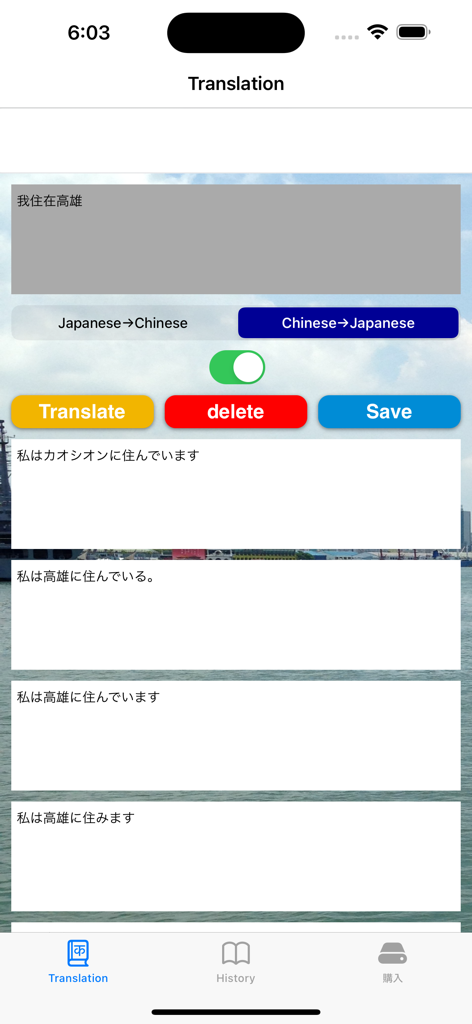
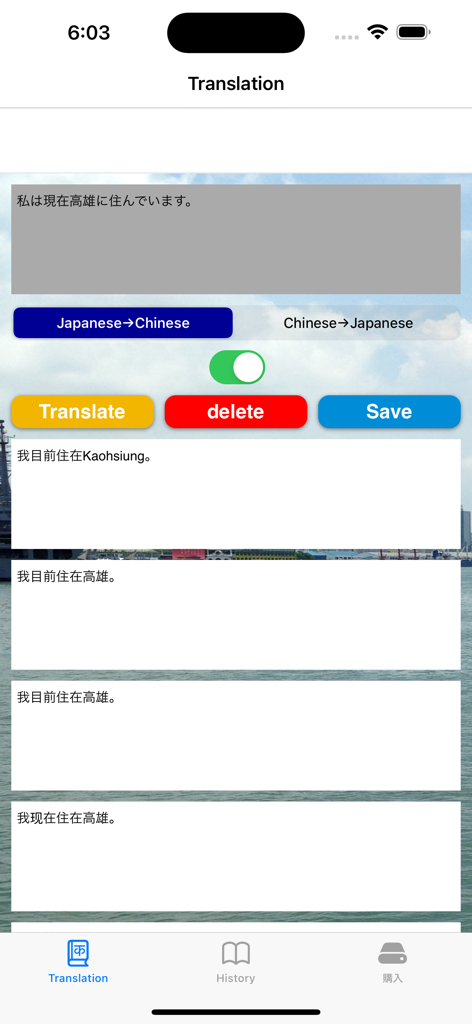
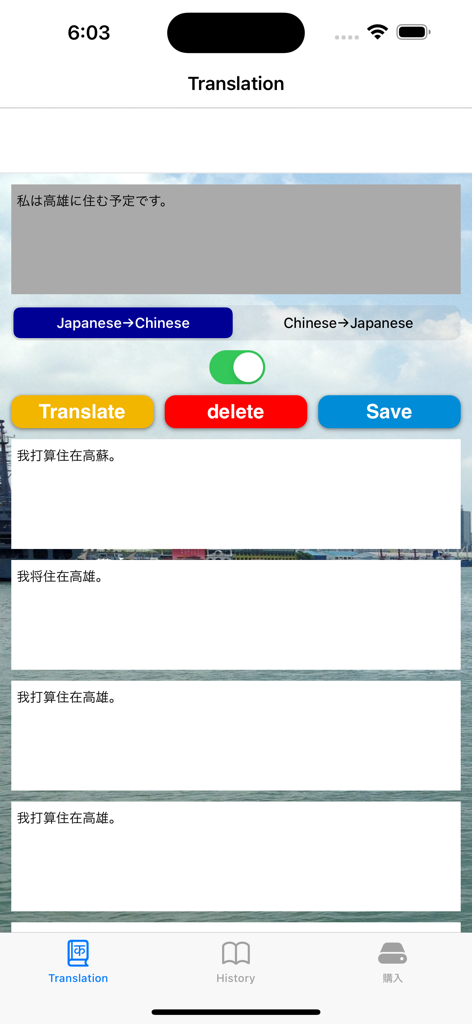
- Efficiently translate Japanese to Chinese or Chinese to Japanese
- Supports Pinyin input and native speaker pronunciation
- Save translation history for easy access
- One-click clear and copy translation results
This app will make your Japanese learning, travel, and work easier. When you watch Japanese dramas, read manga, listen to Japanese songs, or follow Japanese news, this translation tool will help you deeply understand the Japanese context and Japanese culture.
**Translate Japanese to Chinese:**
Suitable for daily work, life, and study. Whether you are communicating with Japanese friends or understanding Japanese entertainment content, this will allow you to understand the Japanese language and culture as deeply as a Japanese person.
**Translate Chinese to Japanese:**
If you need to translate Chinese into more authentic Japanese, this tool can provide standard and colloquial translation results, ensuring smoother communication.
In addition, the app also provides pronunciation for Japanese and Chinese, helping users practice speaking and enhance memory.
**Contact Us:**
If you have any suggestions or questions, please contact us through the "Support" page. We are dedicated to providing you with assistance.
App Support Page URL:
https://learn-language.tokyo/zh-TW/contact-us
**Subscription**
• Title of publication or service
Unlock All Features
***********************
Remove Ads
***********************
• Subscription duration (length of time and content or services offered within each subscription period)
$1.99/1 month
Payment will be charged to your iTunes Account upon purchase confirmation
• Subscriptions automatically renew unless auto-renew is turned off at least 24 hours before the end of the current period
• Your account will be charged for renewal within 24 hours prior to the end of the current period, and the cost of the renewal will be identified
• Subscriptions may be managed by the user, and auto-renewal may be turned off by going to the user's "Account Settings" after purchase
– Link to Terms of Use
https://notguilty-190121.web.app/terms.html
– Link to Privacy Policy in the "Privacy Policy URL" field in iTunes Connect
https://notguilty-190121.web.app/privacy.html
Japanese, also known as Nihongo (Japanese: 日本語/にほんご Nihongo/にっぽんご Nippongo, Japanese pronunciation )、Yamato Kotoba (Japanese: やまとことば Yamato Kotoba), belongs to the Japonic language family and is the language primarily used by the Yamato people of the Japanese archipelago, and is also the ethnic language of the Yamato people. Japan has not explicitly defined Japanese as its official language in its constitution or laws, but various laws stipulate the use of Japanese, which is taught as Kokugo (national language) in school education. Japanese is the public language of Japan and is the de facto official language of Japan, similar to how American English is the de facto national language of the United States.
Although there are no precise statistics on the number of Japanese speakers, considering the population within Japan and Japanese nationals, expatriates, and people of Japanese descent living outside Japan, the number of Japanese speakers should exceed 130 million. Almost all Japanese nationals born and raised in Japan have Japanese as their mother tongue. In addition, for the deaf, there is Japanese Sign Language that corresponds to Japanese grammar and phonological systems.
In Japanese linguistics, unless otherwise specified, "Japanese" (Japanese: 日本語) generally refers to the modern standard Japanese based on the dialect of the middle class in the Edo Yamanote area (around central Tokyo), sometimes called "Kyōtsūgo" (Japanese: 共通語).
Characteristics
In terms of phonology, Japanese is strongly characterized as an open-syllable language (syllables ending in a vowel), except for the geminate consonant "っ" (sokuon) and the nasal consonant "ん" (n). In addition, many dialects, including standard pronunciation, have morae. In terms of accent, it belongs to pitch accent (or non-stress language). Native Japanese words that have been passed down from ancient times have the following characteristics:
1. The kana of the "ra" row do not appear at the beginning of words (hence, words starting with the "ra" row are rarely seen in Japanese word-chain games. Words like "楽らく" (easy), "喇叭らっぱ" (trumpet), and "林檎りんご" (apple) are not native Japanese words).
2. Voiced consonants do not appear at the beginning of words [Words such as "抱だく" (to hug), "どれ" (which), "場ば" (situation), and "薔薇ばら" (rose) did not exist in Old Japanese, and are later changes in Japanese].
3. There are no consecutive vowels within the same word root [The ancient pronunciation of "青あお" (blue) and "貝かい" (shellfish) were "あを" and "かひ" respectively].
(See the "Writing System" and "Phonology" sections)
In terms of word order, sentences are primarily composed of subject, object, and predicate, and it is one of the representative topic-prominent languages. Modifiers precede the modified words. Furthermore, in Japanese, grammatical cases are expressed not by changing word order or endings, but by adding grammatical particles after words. Therefore, in terms of language typology, Japanese is a SOV (Subject-Object-Verb) structure; in terms of morphology, Japanese is an agglutinative language (see Grammar section).
In terms of vocabulary, in addition to native Japanese words that have been passed down from ancient times, there are also Sino-Japanese words introduced from China. Since modern times, the proportion of loanwords from various countries, mainly Western languages, has also gradually increased. (See Types of Vocabulary section)
In terms of expressing politeness, Japanese is extremely varied; there is not only a distinction between spoken and written language, but also distinctions between plain and polite, male and female, old and young, etc. Japanese has a well-developed honorific system in both grammar and vocabulary to express the subtle relationships between the characters being narrated. (See Honorifics section)
Japanese also has a diverse dialect system, especially in the Ryukyu Islands, where dialects differ greatly (see "Dialects" section). Until the mid-modern period (Edo period), when Kyoto was the political and cultural center of Japan, the Kyoto dialect held the status of standard language. In the late modern period, after the Tokugawa shogunate ruled Japan, the Edo dialect's status rose, and finally, based on the Yamanote dialect of the middle and upper classes in Edo Yamanote (Yamanote Kotoba), a new standard language (Kyōtsūgo), i.e., modern Japanese after the Meiji era, was formed.
The writing system of Japanese is relatively complex compared to other languages. Kanji (including Wasei Kanji, with multiple readings such as On'yomi and Kun'yomi), Hiragana, and Katakana are the primarily used scripts, collectively known as Kanji-Kana mixed script, and these three scripts are usually used together to write. In addition, Latin letters (Romaji) and Greek letters (mainly for medical and scientific terms) are also frequently used. Furthermore, Japanese can be written in both horizontal and vertical directions.
In terms of phonology, Japanese syllables are basically composed of "consonant + vowel," with only five vowels, a simple syllable structure, and features such as the opposition between direct and oblique sounds, the phenomenon of "one syllable, two morae," vowel devoicing, and changes in pitch accent due to the formation of compound words.
Distribution
The scope of Japanese usage is mainly within Japan. Although no survey has been conducted on the number of Japanese speakers either inside or outside Japan, it is generally calculated based on the population of Japan.
Within Japan, Japanese is not directly stipulated as the official or national language in laws, but Article 74 of the "Court Act" states: "In courts, Japanese shall be used." Furthermore, the "Act on Promotion of Literacy and Typography Culture" treats "Japanese language" and "Kokugo" as equivalent (Article 3, Paragraph 2: "To promote literacy and typography culture, it is essential to fully recognize that 'Kokugo' is the cornerstone of Japanese culture." Article 9: "The State shall, as far as possible... (omitted)... support the translation of 'Japanese language' publications into foreign languages..."). In addition, all government documents are written only in Japanese, and the content taught in the "Kokugo" subject in all levels of schools is Japanese.
In Japan, Japanese is used in almost all broadcasting fields such as television and radio, and movies, as well as in publishing fields such as novels, manga, and newspapers. When foreign TV series and movies are broadcast, they are almost always translated into Japanese and broadcast with subtitles or Japanese dubbing. Foreign language original publications are also distributed in Japan, but they are mainly academic papers for overseas, publications for foreigners residing in Japan, or for Japanese language learners, and are not intended for the general Japanese public.
Outside of Japan, Japanese is mainly used by Japanese immigrants in areas such as Latin America and Hawaii, but many of them no longer speak Japanese after three or four generations.
In areas that were ruled by the Empire of Japan before World War II, such as Taiwan (Taiwanese Japanese era), Sakhalin and the South Pacific Islands, parts of Northeast China (Manchukuo), Dalian City, and the Korean Peninsula (Korean Japanese era), there are still some people who received Japanese education at that time who can still use Japanese.
After Taiwan was ruled by the Empire of Japan for 50 years following China's defeat in the First Sino-Japanese War, during the "Kōminka" policy, almost all Taiwanese had to learn Japanese. During the Japanese colonial period, Japanese was also the official language of the Korean Peninsula.
In addition, Angaur in Palau has adopted Japanese as one of its official languages. However, there are no residents who use Japanese in daily conversations, and Japanese as an official language is merely a symbolic measure to express friendly relations with Japan.
According to a survey by the Japan Foundation in 2019, the number of learners of Japanese as a foreign language outside Japan in 2018 was approximately 3.84 million. In the People's Republic of China, there were about 1 million learners, in the Republic of Indonesia about 700,000, in the Republic of Korea about 530,000, in the Commonwealth of Australia about 400,000, and in the Republic of China about 170,000. Learners in East Asia and Southeast Asia accounted for about 76.8% of all learners. Japanese language education is offered in 142 countries and regions. In addition, according to a survey by the Agency for Cultural Affairs in 2015, the number of Japanese language learners from overseas within Japan reached approximately 190,000, of whom about 160,000 were Asians.
In the ranking of internet usage languages in March 2017, Japanese was ranked eighth, following English, Chinese, Spanish, Arabic, Portuguese, Indonesian (Malay), and French.