
Brainf*ck

Brainf*ck

Download on App Store
Logo of Brainf*ck

Brainf*ck: The Definitive Esoteric IDE for Logic Purists

Strip away the abstractions and master the legendary 8-command language. Challenge your logic with extreme minimalism in this Turing-complete playground for the intellectual elite.

Publisher

Sergey Vanichkin

Category

Developer Tools

Downloads

45K+

User Rating

2.9/5

Total Ratings

0

Locales

2

Logic in Action

Discover the interface used by 45K+ users.
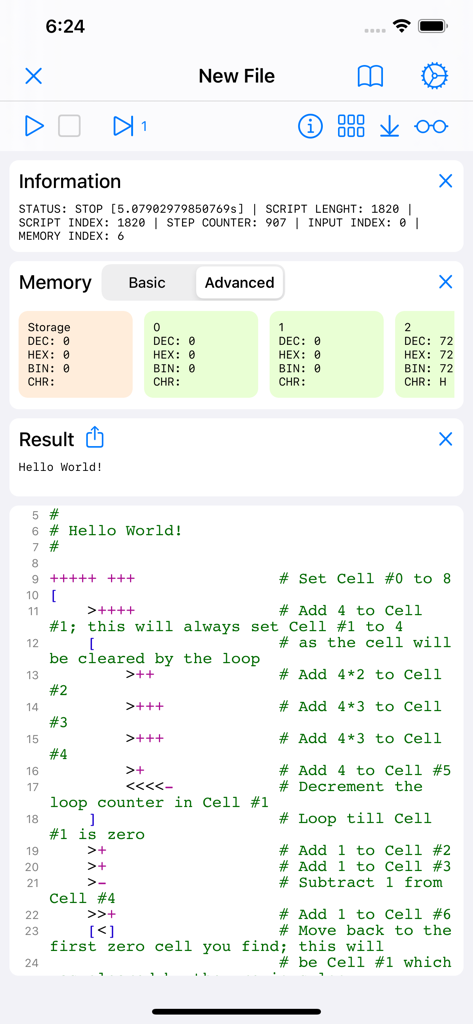
Interface of the Brainfuck IDE app showing a code editor with memory cell values and debug information

Interface of the Brainfuck IDE app showing a code editor with memory cell values and debug information

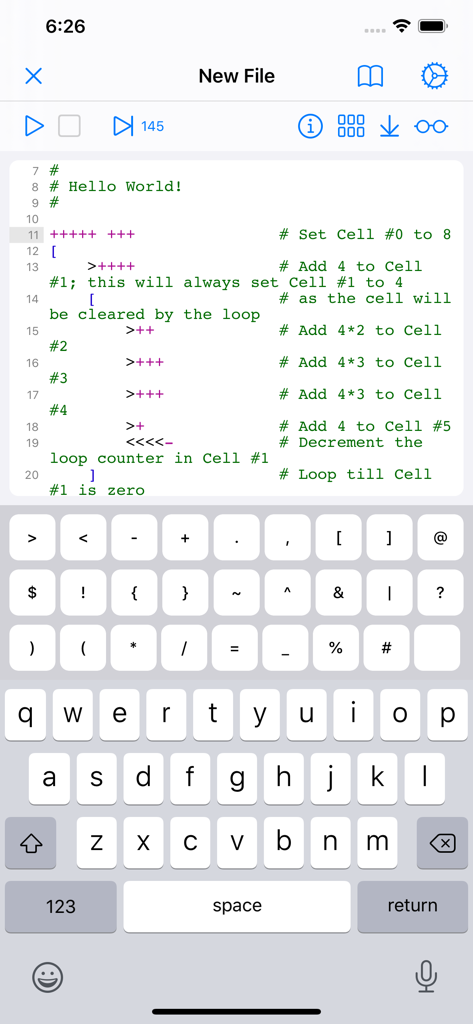
Brainfuck IDE mobile code editor interface showing a Hello World script with a specialized programming keyboard

Brainfuck IDE mobile code editor interface showing a Hello World script with a specialized programming keyboard

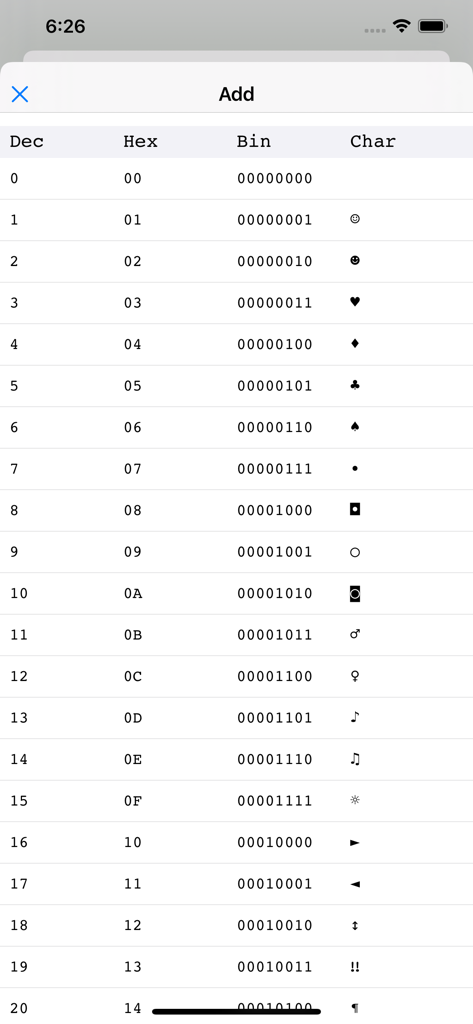
An ASCII conversion table in the Brainfuck IDE showing decimal hexadecimal and binary values

An ASCII conversion table in the Brainfuck IDE showing decimal hexadecimal and binary values

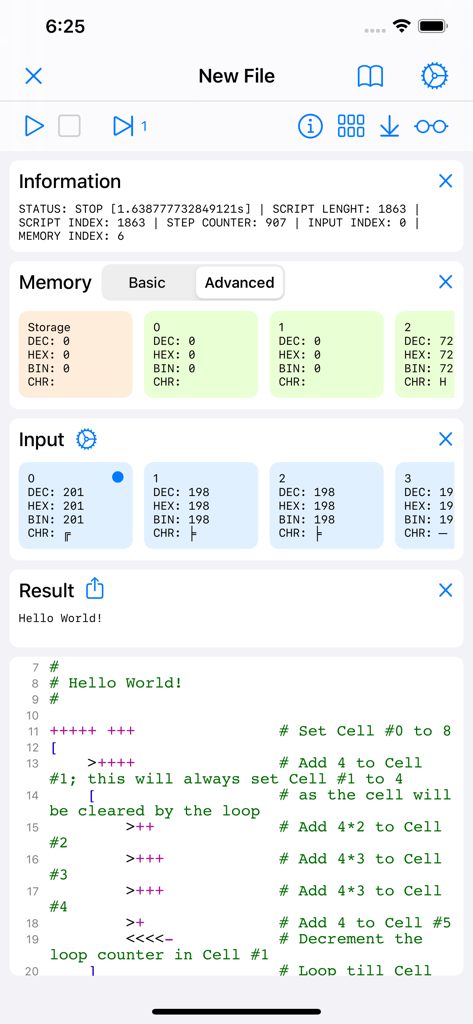
Brainfuck IDE mobile app interface showing source code and memory debugger

Brainfuck IDE mobile app interface showing source code and memory debugger

Master the Minimalist Challenge

The tools that make this app stand out, trusted by 45K+ users.

💻

Desktop-Grade Mobile IDE

A specialized environment for esoteric coding. Write, test, and debug your micro-commands wherever your curiosity takes you.

🧠

Real-Time Memory Tracking

Visualize the instruction pointer and data cells in action. Understand exactly how your code manipulates memory at the most granular level.

⚙️

Pure Turing Completeness

Solve complex logic puzzles with zero abstractions. Experience the raw satisfaction of building something useful with just eight simple characters.

About the app

Everything you need to know about Brainf*ck.

Description

Brain***k IDE is an esoteric programming language created in 1993 by Urban Müller, and is notable for its extreme minimalism. The language consists of only eight simple commands and an instruction pointer. While it is fully Turing complete, it is not intended for practical use, but to challenge and amuse programmers. Brain***k simply requires one to break commands into microscopic steps. The language's name is a reference to the slang term Brain***k, which refers to things so complicated or unusual that they exceed the limits of one's understanding. History In 1992, Urban Müller, a Swiss physics student, took over a small online archive for Amiga software. The archive grew more popular, and was soon mirrored around the world. Today, it is the world's largest Amiga archive, known as Aminet. Müller designed Brain***k with the goal of implementing it with the smallest possible compiler, inspired by the 1024-byte compiler for the FALSE programming language. Müller's original compiler was implemented in machine language and compiled to a binary with a size of 296 bytes. He uploaded the first Brain***k compiler to Aminet in 1993. The program came with a "Readme" file, which briefly described the language, and challenged the reader "Who can program anything useful with it? :)". Müller also included an interpreter and some quite elaborate examples. A second version of the compiler used only 240 bytes. As Aminet grew, the compiler became popular among the Amiga community, and in time it was implemented for other platforms. Several Brainf*ck compilers have been made smaller than 200 bytes, and one is only 100 bytes. Language design The language consists of eight commands, listed below. A Brain***k program is a sequence of these commands, possibly interspersed with other characters (which are ignored). The commands are executed sequentially, with some exceptions: an instruction pointer begins at the first command, and each command it points to is executed, after which it normally moves forward to the next command. The program terminates when the instruction pointer moves past the last command. The Brain***k language uses a simple machine model consisting of the program and instruction pointer, as well as an array of at least 30,000 byte cells initialized to zero; a movable data pointer (initialized to point to the leftmost byte of the array); and two streams of bytes for input and output (most often connected to a keyboard and a monitor respectively, and using the ASCII character encoding). Privacy policy: https://static.macflash.ru/PRIVACY_POLICY_EN Terms of use: https://static.macflash.ru/TERMS_OF_USE_EN

Latest Version

2.5

Size

8.3 MB

First Released

Jan 13, 2012

Master the Eight Commands

Urban Müller challenged the world to build something useful with it. Are you ready to take your logic to the microscopic level? Download now.

Download on App Store

App information, icons, screenshots, and descriptions displayed on this page are sourced from the Apple App Store and are the property of their respective developers. Download estimates and rankings are based on MWM's proprietary models and may not reflect actual figures. This page is provided for informational and analytical purposes only.

Believe this page infringes your intellectual property? File a dispute