Tug kW Power
Tug kW Power
Download on App Store

This page is not an official page of the app or its developer, but an independent editorial publication created for informational and commentary purposes. Unless expressly stated otherwise, neither the app nor its developer is affiliated with, endorsed by, sponsored by, authorized by, or otherwise officially connected with MWM, Apple, Google Play, the app publisher, or the app's developer, and nothing on this page implies that the app was developed using MWM's services. Any trademarks, logos, screenshots, and other content remain the property of their respective owners.

Logo of Tug kW Power
Download on App Store

Tug kW Power

Ensure safety and regulatory compliance with DNV-aligned calculations for barge towing operations. Instantly generate professional PDF reports and verify tug suitability directly from the field, even without an internet connection.

Key Figures

Downloads

0

User Rating

1.0/5

Total Ratings

0

Publisher

Matthew Ricciardo

Category

Productivity

Locales

1

Latest Version

5.0

Size

1.4 MB

First Released

Sep 22, 2021
Features

Engineered for Maritime Precision

Tug kW Power provides marine professionals with the industry-standard tools needed to calculate bollard pull and engine requirements with absolute confidence, ensuring safety and regulatory compliance in high-stakes environments.

Compliant with Global Standards

Perform calculations based on DNV-RP-H103 and ABS rules. Our logic ensures your data is defensible for 3rd party surveyors and international certification agencies.

Field-Ready PDF Reporting

Generate and AirPrint professional reports directly from the deck. With full offline capability and local data saving, you can finalize client documentation without an internet connection.

The following screenshots and description are sourced directly from the app's official store listing and are the property of the app developer.

App Store

Screenshots
Tug kW Power - Tug kW Power app splash screen featuring a black PV logo with wave icons on a white background
Tug kW Power app splash screen featuring a black PV logo with wave icons on a white background

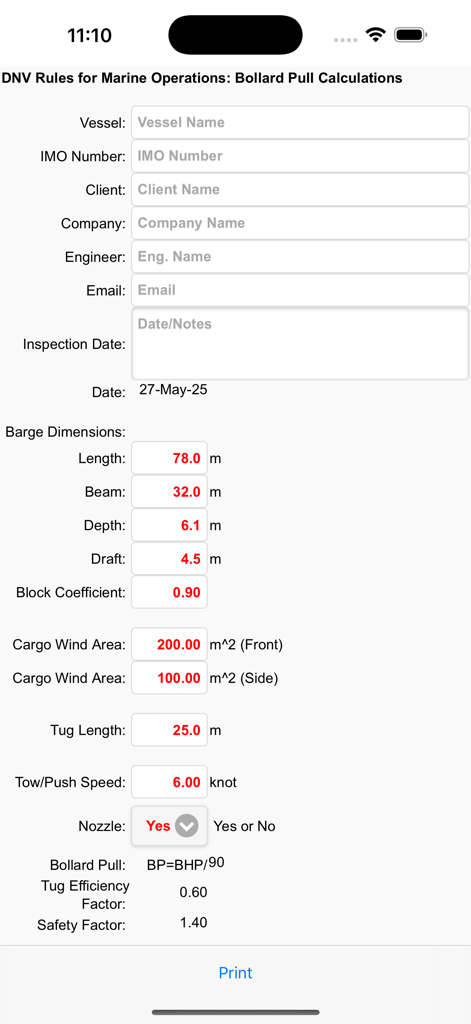
Tug kW Power - Bollard pull calculation form for marine operations in the Tug kW Power mobile app.
Bollard pull calculation form for marine operations in the Tug kW Power mobile app.

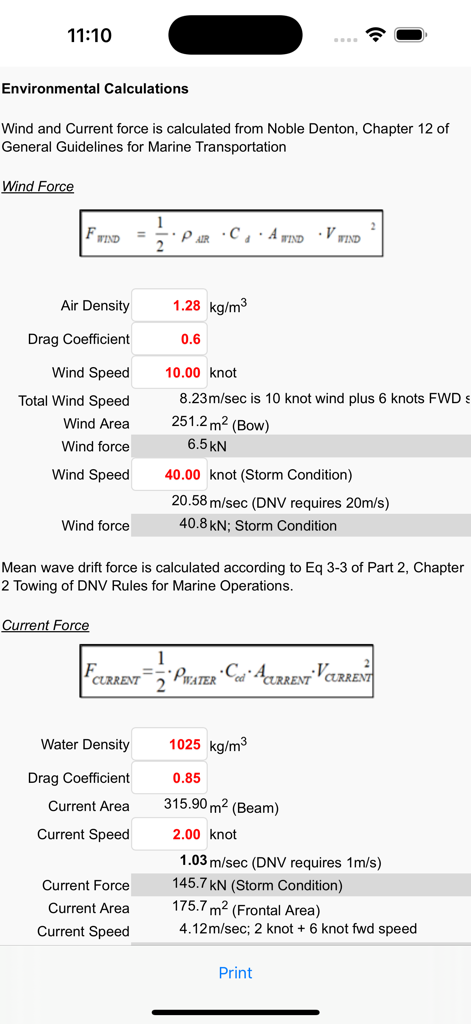
Tug kW Power - Environmental calculations screen of the Tug kW Power app showing wind and current force formulas and input fields for maritime engineering.
Environmental calculations screen of the Tug kW Power app showing wind and current force formulas and input fields for maritime engineering.

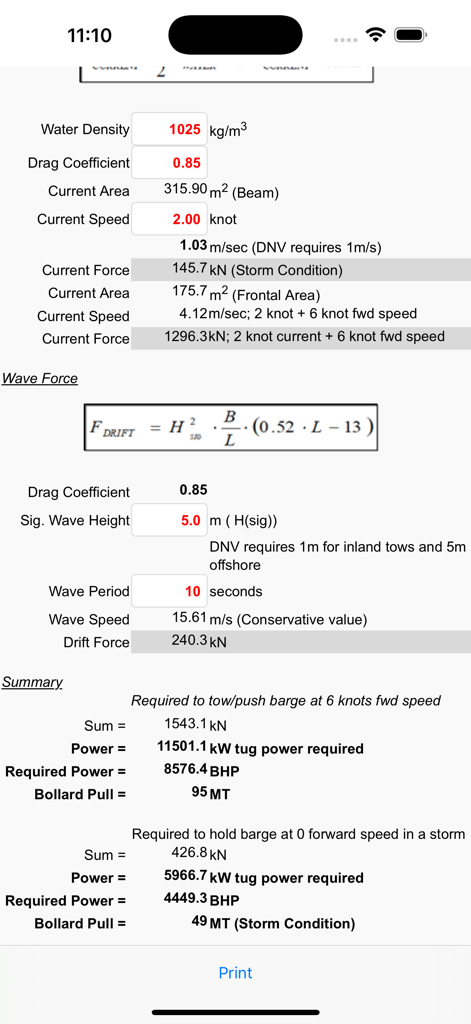
Tug kW Power - Summary of tug power and bollard pull calculations for towing and storm conditions in the Tug kW Power app
Summary of tug power and bollard pull calculations for towing and storm conditions in the Tug kW Power app

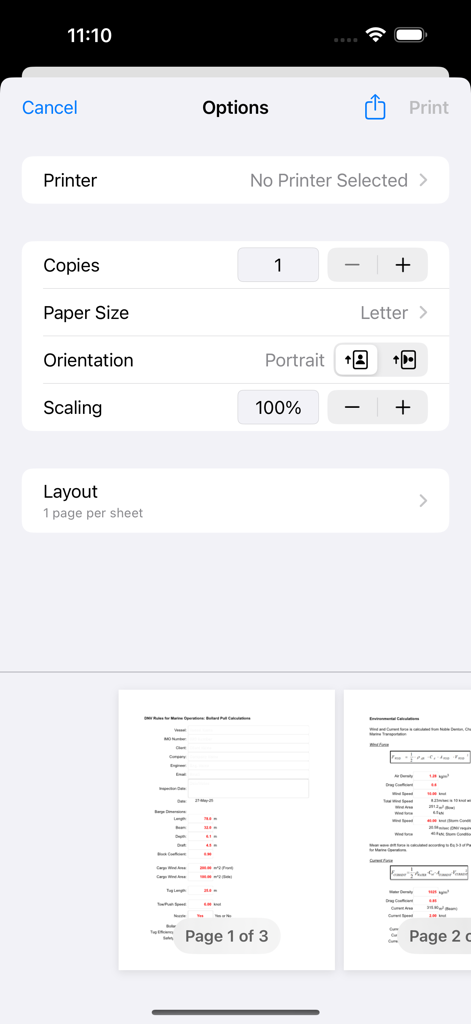
Tug kW Power - Print options and PDF report preview for maritime bollard pull calculations

Print options and PDF report preview for maritime bollard pull calculations

Description

Bollard Pull Calculator (METRIC UNITS) The app will calculate the required bollard pull and power to push or tow a barge or group of barges in open water or inland waterways (protected waters). The calculations can be certified by Det Norske Veritas (DNV) or for 3rd party surveyors. App is useful for tug operators, captains, operational management, and Naval Architects and Marine Engineers involved in Marine Towing Operations for selection of tug for push/towing operations. What does this App do? This app uses data collected by the user to calculate the tug's power and bollard pull required to push a barge at a specified speed and environment. The app also calculates the tugs power and bollard pull required for a storm condition to hold a barge. The bollard pull is shown in MT and required Power of the tug is in HP and kW. It is recommended to have a Bollard Pull certificate for the tug but is not required as it is already factored into the calculations. The app should be used to select the appropriate tug (propulsion system) based on the required Bollard Pull. Alternatively, it can be used to check whether a selected tug is suitable before the towing operation proceed. How to use this app? The apps inputs are in red. The input requires barge dimensions (although this doesn't have to be a barge) and deck cargo dimensions to calculate the areas the environment will act upon. The calculations are in black and automatically update with each input. Once finished with the inputs, use the print button to air print, save as a PDF or email PDF. The input values will be saved on the app allowing the user to still take calls, email, etc. without losing their data entry. When the app is closed, the app will reset to the default values. No internet connection is required to save the output as a PDF or to use the app. The print output or pdf can be used in a report to submit to client. A 25mm margin at top and bottom can be used for your company info using Adobe or similar PDF editor. Do not edit the calculated values in pdf editor and always save a PDF copy of the calculations for your records. All calculations are done using DNV recommendations and Naval Architecture and Marine Engineering best practices. These calculations can be certified by DNV using the PDF printout. Additional details about the scope of work is provided by you such as the deck layout, selected tug, and vessel certificates. The input units for this app are Metric (meters, etc). A English (feet, etc.) version of this app is available in the App Store. All the calculations are in SI units. This is required by most 3rd party certification agencies operating in the USA and Europe. Limitations: It is up to the user to input good data into the app. The hull of the vessel is input into the app and those calculations are already done for you. The area of the cargo requires the user to measure the front and side areas for input into the app. It is best to estimate it as a rectangle rather than measure every item and add their areas. This will save time and it is better to overestimate than underestimate wind area. Stability calculations should be done separately to ensure vessel safety and proper seafastening is installed. References 1. DNV-RP-H103, 2011, Sec 7.2.6 2. ABS Rules for Building and Classing Mobile Offshore Drilling Units, 2019, C 3-1-2/1.3.2

Download

Download on App Store

This page is not an official page of the app or its developer, but an independent editorial publication created for informational and commentary purposes. Unless expressly stated otherwise, neither the app nor its developer is affiliated with, endorsed by, sponsored by, authorized by, or otherwise officially connected with MWM, Apple, Google Play, the app publisher, or the app's developer, and nothing on this page implies that the app was developed using MWM's services. Any trademarks, logos, screenshots, and other content remain the property of their respective owners.